
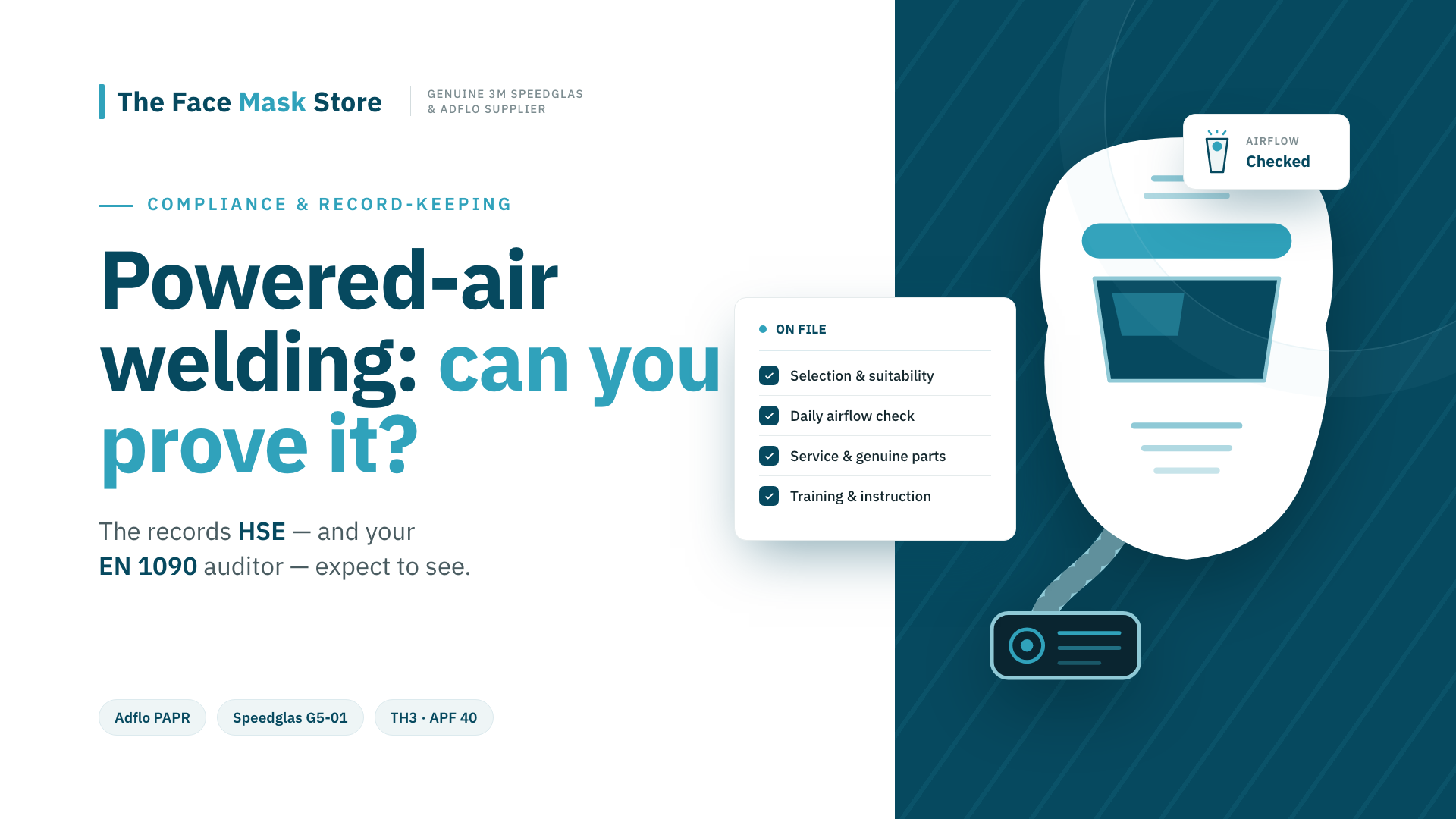
You can buy the right respirator and still fail an inspection. Your powered-air welding RPE — a 3M Speedglas G5-01 with an Adflo blower, say — only counts for as much as the paperwork behind it. An HSE visit, or an EN 1090 surveillance audit, does not turn on what hangs in the PPE store. It turns on what you can show: that the powered-air welding RPE you chose suits the fume your welders breathe, that someone checks it every shift, and that you maintain it on a schedule. The kit is half the legal duty. The evidence is the other half — and it is the half that trips good fab shops up.
If your shop has moved to powered-air welding helmets — a 3M™ Speedglas™ G5-01VC with an Adflo™ powered air (PAPR) system, say — this guide is the part nobody sells you with the kit. It sets out, role by role, what you need to write down and keep so that the powered-air decision stands up. It is written for the three people who actually carry that proof between them: the procurement manager who specs and supplies it, the HSE manager who owns the respiratory programme, and the welding coordinator who now has to fold it into the welding quality system.
📋 Key takeaways
- “Suitable” is a documented decision, not an opinion. You need a written line from the welding-fume risk to the respirator you chose — not just the respirator.
- Loose-fitting powered headtops drop the face-fit test — they do not drop the paperwork. No fit test, but the RPE programme, training, supervision, maintenance and records all still apply. This is the single most common misunderstanding.
- A pre-use check nobody records did not happen. The Adflo airflow check takes seconds; logging it is what turns it into evidence.
- Maintenance is an evidence chain. Genuine consumables, replaced on schedule, recorded, with someone named as responsible — kept for years, not binned.
- For EN 1090 fabricators, welding-fume control is now the coordinator’s business too. The standard their competence is measured against was updated to put health, safety and the environment squarely in scope.
Why proof is the part that fails, not the kit
Since 2019, HSE has treated mild-steel welding fume as a cause of cancer with no known safe level of exposure, and expects effective controls for all welding — local exhaust ventilation (LEV) for indoor work, and suitable respiratory protective equipment (RPE) for the fume LEV does not capture and for welding outdoors. (We set the rules out in full in our welding fume control and HSE requirements guide.)
Most shops get the engineering of that right. Where they come unstuck is the paper trail. Under COSHH you have to provide suitable RPE, maintain it, and keep records of that maintenance and testing — and an inspector will ask to see those records, not just the respirator. A powered-air helmet that is genuinely the right choice can still leave you exposed if you cannot show why it was chosen, that it is checked before use, and how it is kept in working order. That is what this guide builds.
If you are still weighing the powered kit against cheaper masks on cost, start with our companion piece — is a powered welding respirator worth it? — and come back here once you have bought.
Who owns what — the evidence at a glance
Three roles, one evidence trail. Splitting it cleanly is half the battle, because the gaps are usually where two people each assumed the other had it.

Use that as the spine. Each row becomes a record you can hand over; the rest of this guide is how to build each one.
“No fit test” is not “no paperwork”
This is the point most shops get wrong, so it is worth being blunt about.
A powered, loose-fitting headtop like the Adflo does not need a face-fit test. It works with beards and stubble, and there is no per-person, per-mask test to schedule or re-do. That is a genuine saving over tight-fitting disposables and half-masks, which must seal to a clean-shaven face and be fit-tested for every wearer. HSE’s fit-testing guidance (INDG479) is explicit that loose-fitting powered headtops are exempt from fit testing while tight-fitting facepieces are not.
What dropping the fit test does not do is drop the rest of your powered-air welding RPE programme. With powered air you still owe:
- a documented selection showing the RPE is suitable for the task and the fume;
- training so wearers can fit, check, use and look after the headtop, and know its limits;
- supervision that it is actually worn and used correctly;
- maintenance to the manufacturer’s instructions, with records;
- and a pre-use check before every use.
So the trade is not “powered air means no admin.” It is “powered air swaps the fit-test regime for an airflow-check-and-maintenance regime.” Lighter, in our view — but only if you actually run it.
Selection evidence — proving it’s suitable
“Suitable” is a word with weight in COSHH, and it has to be a decision you can show your working on. The record does not need to be long; it needs to connect the dots:
- The hazard. What is being welded (mild steel, coated, galvanised, stainless), the process, the duration, and the setting (open bay, enclosed, outdoors). Link it to your COSHH assessment rather than repeating it.
- The control hierarchy. LEV first for indoor work; RPE for the residual fume and for outdoor or awkward-access welding where LEV cannot reach.
- The protection level. The RPE you provide for welding should carry an assigned protection factor (APF) of at least 20. A disposable FFP3 or a reusable half-mask with P3 filters gives APF 20; a TH3 loose-fitting powered headtop such as the Adflo gives APF 40 — useful headroom for heavier or more variable fume. (These are HSE figures from HSG53.)
- Why powered air here. Daily or long-duration welding, higher or variable fume, coated/stainless material, bearded crews, or the wear-time and comfort that mean the protection is actually worn — each a legitimate, recordable reason.
Write those four down once per role or work area and you have the suitability record an inspector asks for. If you ran a structured wear trial before buying — our 30-day wear-trial playbook shows how — the trial scorecards and acceptance sign-off are the first exhibits in that record. The kit this guide is built around is the G5-01VC + Adflo PAPR (617830); the same logic applies whichever powered system you run.
In-use evidence — the daily check that has to be logged
A powered respirator only delivers its protection while it is actually moving enough clean air. So the Adflo is designed to be checked before every use, and that check is your single most important day-to-day record.
The airflow check is quick: with the system assembled and the filter fitted, run the blower, hold the airflow indicator vertical, and confirm the float sits at or above the minimum-flow mark — and that the low-flow alarm sounds when tested. In use, the alarm warns the wearer if airflow falls below the manufacturer’s minimum design flow (around 160 l/min). None of that protects you on paper, though, unless someone records that it was done.
A workable daily log is four columns: date, welder/unit ID, airflow check pass/fail, and issues reported. Give every headtop and blower a unique ID and log against it — that ID is what lets you show an inspector a continuous history for a specific unit, and it is what turns “we check them” into “here is the check, on this unit, on that day.” Capture wearer-reported problems in the same place; a niggle logged early is a filter or battery changed before it becomes an exposure.
Maintenance & service evidence — a recorded schedule, not a habit
This is where procurement and HSE meet. Maintenance to the manufacturer’s instructions is a legal requirement; records of that maintenance and testing are what you produce on demand. Treat the Adflo’s consumables as a recorded service schedule, not an ad-hoc “change it when it looks tired”:
- Pre-filter (836010) — the cheap part that protects the expensive one; changed frequently to keep the particle filter clean.
- Particle filter (837012) — replaced when it loads up, indicated by the filter indicator or by airflow falling toward the alarm.
- Spark arrestor (836000) — inspected and replaced when deformed or damaged.
- Heavy-duty battery (837631) — charged and condition-checked; replaced within its working life rather than run to failure.
- Breathing tube (834016) and head-top seal — checked for splits, wear and a secure connection.
What makes your powered-air welding RPE records hold up
Two things turn this into an evidence chain rather than just maintenance. First, genuine 3M parts, so the unit still performs and certifies as designed — record the parts used and where they came from. As a supplier sourcing genuine 3M parts through authorised 3M distributors, we keep that supply traceable, which is exactly what a “where did this filter come from?” question needs.
Second, name a responsible person and keep the record: who maintains the fleet, on what schedule, with the examination and test results retained. Log each examination, test and any repair, and keep it for at least five years from the date you made it — that is the COSHH requirement, so a unit’s history outlives the shift it covers. (Your daily airflow-check logs sit alongside as programme evidence rather than statutory examination records, but keep them for the same period.)
Procurement’s job here is quiet but decisive: a consumables and service supply that keeps the chain unbroken, so the schedule never slips because the right filter was not on the shelf.
The welding coordinator’s stake — new ground for EN 1090 shops
If your shop CE/UKCA-marks structural steelwork to BS EN 1090, you already run a welding coordinator (often called the responsible welding coordinator), and a welding quality system under Factory Production Control. Welding-fume RPE used to feel like the HSE manager’s problem, parallel to that system. It is no longer so cleanly separate.
The standard a welding coordinator’s competence is measured against — BS EN ISO 14731 — was updated in its 2019 edition to add health, safety and the environment to the coordinator’s listed responsibilities. EN 1090-2, in turn, requires a competent welding coordinator for execution classes EXC2 to EXC4, which covers the great majority of marked structural and heavy fabrication work. Put those together and the welder’s respiratory protection is no longer outside the coordinator’s remit — it sits alongside procedures, qualifications and weld quality as part of how the welding operation is controlled.
In practice that means the powered-air welding RPE records above are not a separate pile from your FPC file — they are part of it. The selection rationale, the airflow-check logs, the maintenance schedule and the training records all belong in the same welding quality evidence the coordinator already maintains for an EN 1090 audit. A loose-fitting TH3 system helps here precisely because it is low-friction to evidence: no fit-test register to keep current across a changing crew, one clear pre-use check, and a consumables schedule that reads like any other planned maintenance.
ISO 14731 does not require a PAPR, and neither does EN 1090. They put welder health and safety in the coordinator’s scope; your COSHH assessment and HSE’s RPE guidance then decide the right level of protection. The point is that the coordinator is now a stakeholder in that decision, not a bystander to it.
Training, supervision and the limit you must write down
Two more records close the loop.
Training and instruction. Keep a record that each wearer has been shown how to assemble and don the headtop, how to run the pre-use airflow check, how to change consumables, and — importantly — what the system cannot do. Powered air is simple to use, which is exactly why the limits get skipped.
A powered air-purifying respirator filters the air around the welder; it does not supply oxygen. It is not suitable for oxygen-deficient or potentially oxygen-deficient atmospheres, or for confined spaces where shielding or purging gas can displace the air. Those call for a supplied-air system, not a PAPR. Where your work includes tank or vessel entry, that boundary needs to be written into the risk assessment and the training record — both as a safety control and as evidence you considered it. If your work spans both, talk to us before you spec anything, because the answer is two different systems, not one.
Your powered-air welding RPE record pack
To make this practical, we have put the four records above into a single, adaptable Powered-Air Welding RPE Compliance Record Pack you can download and make your own:
- RPE selection & suitability record — the four-step “why this respirator for this fume” sheet.
- Daily pre-use airflow check log — date / unit ID / pass-fail / issues, ready to print for the welding bay.
- Consumables & service log — scheduled pre-filter, particle filter, spark arrestor, battery and tube checks, with parts used.
- Training & instruction record — including the confined-space limit.
Treat it as a starting framework to sit underneath your own COSHH assessment, not a guarantee of compliance — your assessment and your work decide the detail. But it gives the three roles a shared shape to fill in, instead of three people each keeping half a record.
Frequently asked questions
Do powered welding helmets need face-fit testing?
No. Loose-fitting powered headtops such as the Adflo do not require a fit test and work with beards. Tight-fitting disposables and half-masks do require fit testing, per person and per mask type. But powered air still needs the full RPE programme — training, supervision, maintenance and records.
What records does an HSE inspector actually ask to see for powered-air welding RPE?
Broadly: your COSHH assessment, the RPE selection rationale, evidence the RPE is maintained and examined with records kept, training records, and — for powered air — the pre-use airflow checks. Continuous records against identified units are far stronger than a general “we check them”.
How long do we keep RPE maintenance records?
Keep a record of each RPE examination, test and any repair, and keep it available for at least five years from the date it was made — that is the COSHH requirement. Daily pre-use airflow-check logs are programme evidence rather than statutory examination records, but keeping them for the same period is sensible.
Does EN 1090 / ISO 14731 require powered air?
No. EN 1090 requires a competent welding coordinator (per ISO 14731) for EXC2–EXC4, and the 2019 ISO 14731 added health, safety and the environment to that coordinator’s responsibilities — so welder respiratory protection is now within their scope. The type of RPE is decided by your COSHH assessment, not by the welding standards.
What is the Adflo pre-use airflow check?
Before each use, run the blower and confirm the airflow indicator’s float sits at or above the minimum-flow mark; the unit also alarms in use if airflow drops too low. Record that the check was done, against the unit’s ID.
Get the records — and the supply — right together
Powered air is the easier system to evidence, but only if the consumables turn up on schedule and the parts are genuine and traceable. We supply genuine 3M Speedglas / Adflo equipment, sourced through authorised 3M distributors — the G5-01VC + Adflo kit (617830) — keep your genuine consumables coming on a schedule that matches your service log, and point your team at the right pre-use check, so the evidence chain never breaks because a filter was out of stock.
If you are already running Adflo packs and only need to refresh the helmet, the G5-01VC helmet-only (611130) is the route — confirm compatibility with your existing Adflo and breathing tube with us first.
Contact TFMS through the website contact form, by phone on 01749 938 160, or by email at [email protected].


